ΔE
Color response
Record the target, instrument, illuminant, profile, pass mode and measured difference. A number without test conditions is not portable evidence.
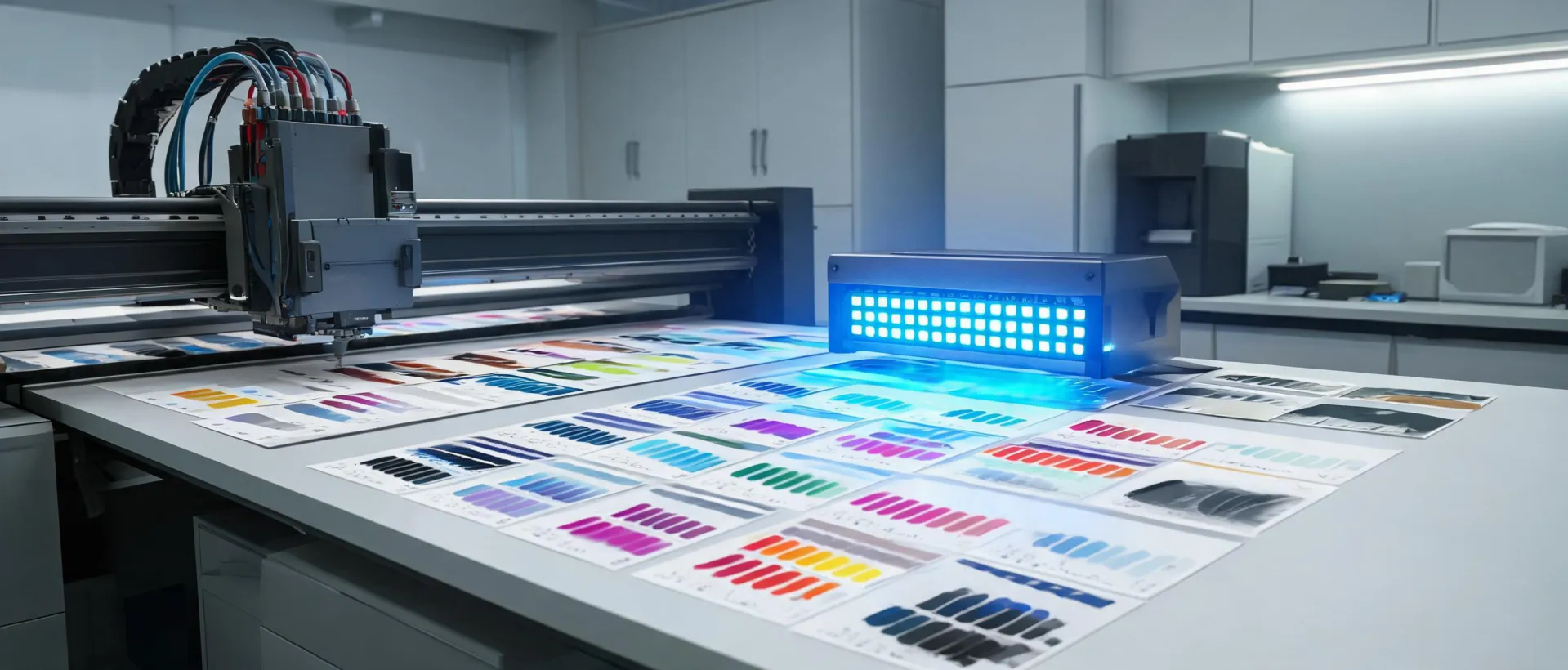
New capability becomes useful when its operating window can be described, reproduced and compared against a stable baseline. The dashboard organizes an innovation evidence register from control variables through production release.
The values below are method definitions, not unpublished performance claims. Each tile names what to capture during a comparative run.
Record the target, instrument, illuminant, profile, pass mode and measured difference. A number without test conditions is not portable evidence.
Compare color, white and clear order, deposited layer behavior and surface effect against cure conditions and fixture height.
Archive nozzle checks before and after the trial. Missing jets can distort a comparison between profiles, pass counts or ink loads.
Measure feed and contour registration across the intended width, roll tension and environmental range rather than on a short proof alone.
Where measurement is available, relate UV dose or thermal exposure to speed, adhesion, flexibility, odor and material sensitivity.
Keep substrate identity and preparation with the approved sample. A lot or coating revision can change wetting, adhesion and color.
These document types create an audit trail without inventing external papers or certifications. They can be completed with the results of a customer-authorized application test.
Substrate identity, preparation, surface observation, ink channel set, cure route, adhesion method and the boundary of the result.
RIP and profile version, measurement device, target, pass mode, linearization state, viewing condition and approval signature.
Image coverage, pass count, carriage mode, media changes, maintenance, cure or drying wait, finishing and expected operator intervention.
Wash, rub, adhesion, laminate, bend or forming procedure; acceptance threshold; photographs; date; reviewer and sample identifier.
Innovation does not need inflated claims. It needs a sequence that exposes benefits and trade-offs before an operator is asked to rely on it.
Name the current constraint: opacity, adhesion, gamut, texture, feed accuracy, cure sensitivity, changeover time or finishing compatibility.
Hold the baseline stable and vary one documented parameter. Include a control sample so visual improvement is not judged from memory.
Extend the test across working width and a realistic run duration. Watch transport, ink stability, curing margin and maintenance interruptions.
Complete pressing, cutting, laminating, washing or forming. A print-stage gain may move cost or failure risk into finishing.
Approve a recipe with revision ownership, training notes and a revalidation trigger for material, ink, firmware or process changes.
Speed versus image and cure margin: a faster mode may change banding visibility, white density, dry-down or adhesion.
Direct print versus transfer: direct printing can remove steps, while a transfer route may isolate the final substrate from the printer transport path.
Specialty channels versus maintenance: white or clear layers add capability but can increase circulation, cleaning and nozzle-management demands.
State the improvement you seek, the baseline you use today and the finished test that will decide whether the change is ready.